


The Man Who Makes His Own Alkali
He runs an aviation software company. He is also collecting barbecue ash to ferment an indigo vat, and the two turn out to be the same story.
By Ken Nishimura
Former editor-in-chief, TechCrunch Japan
I went to Iidabashi to ask about flight operations software. We got to indigo instead.
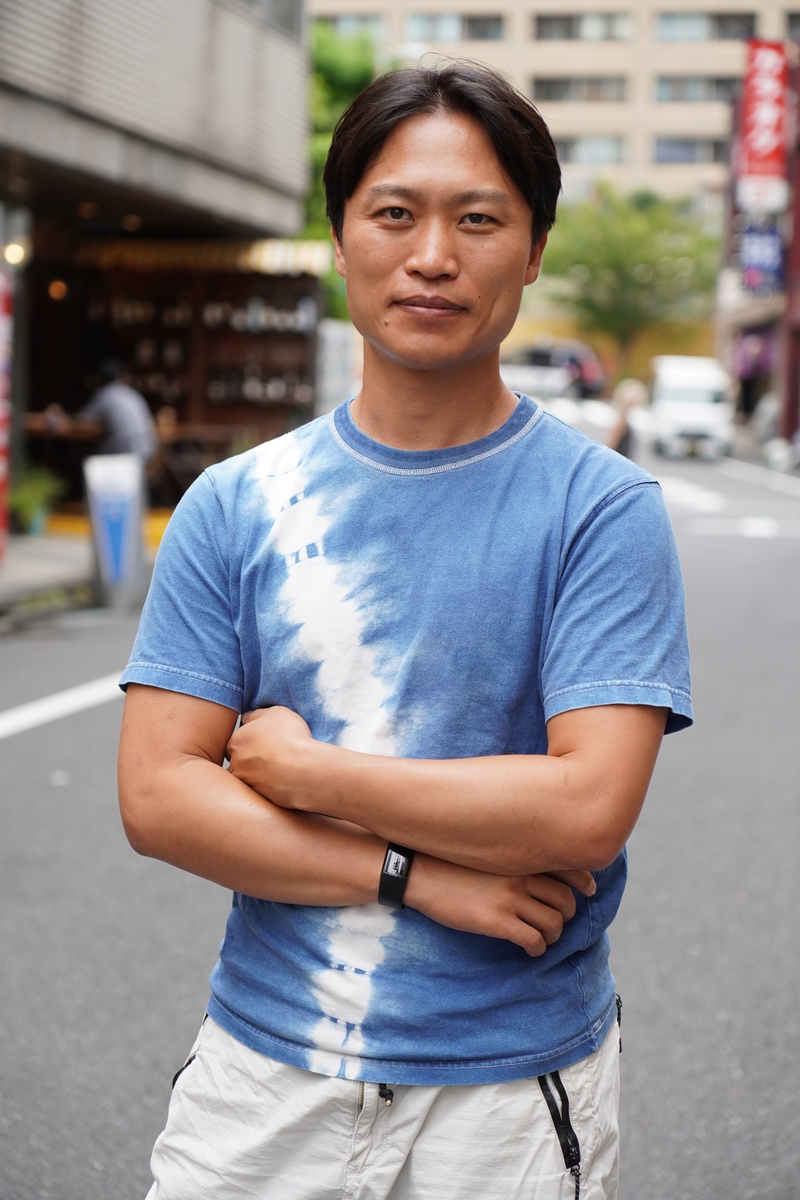
The office is on the fifth floor of an unremarkable building a few minutes from the station, in a part of Tokyo that no one would describe as a technology district. Someone was wearing a T-shirt in an uneven, deep blue that clearly had not come off a rack. I asked about it. Shinji Tanaka, the founder and chief executive of NABLA Mobility, brightened in a way that suggested the question was overdue.
Tanaka runs a five-year-old company that sells software to airlines. Its argument, reduced to a sentence, is that commercial aviation is a great deal less finished than it appears. Underneath a system famous for its precision there is a surprising quantity of unresolved engineering, and some of it is worth money.
I mention the T-shirt because it turns out to be the same argument.
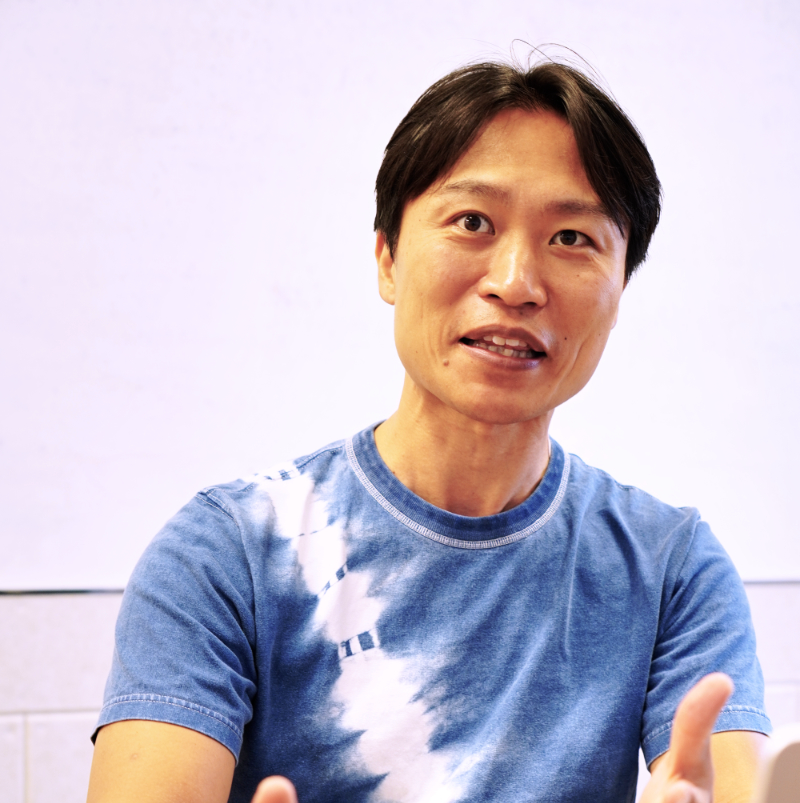
Shinji Tanaka, founder and chief executive of NABLA Mobility, at the company's office in Iidabashi. The shirt was dyed by the team, in a vat of fermented indigo.
The shirts were a company project. A colleague who had been working from overseas came to Japan for the first time, and Tanaka decided the team should do something together. He bought a stack of plain white shirts, and they went to a workshop that still dyes with fermented indigo rather than the synthetic kind. Everyone tied their own resist pattern and dropped their shirt in the vat. His own line came out crooked. He was still slightly annoyed about it.
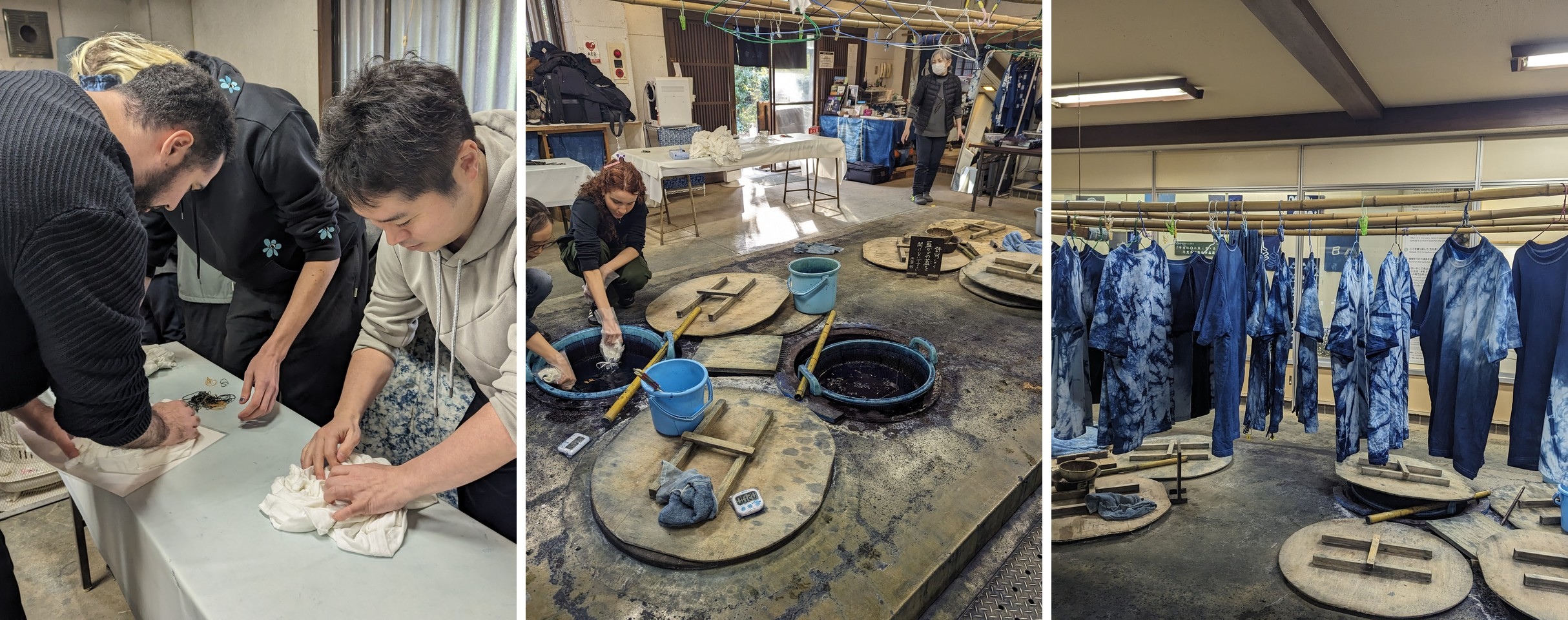
Tying the resist, dipping, and the results on the line. The workshop keeps a fermented vat rather than a synthetic one, which is the part Tanaka wanted to talk about.Then he explained, at some length, why the fermentation matters. To revive a fermented indigo paste so that it will actually take to cloth, you need alkali. The cheap way is to buy caustic soda and stir it in, which works, except that it kills the microorganisms in the vat, and with them the antibacterial and odour-resisting properties that are half the point of fermented indigo in the first place. The traditional route is to make lye from wood ash. So Tanaka has been collecting ash. He has been holding barbecues, quietly, and keeping what is left in the grill. "It seemed like it would be interesting to do it that way," he said. He has not actually built the vat yet. There is a logistical obstacle. "It smells terrible," he said. Fermentation does. He cannot do it at home, so he has been eyeing the space around the office, wondering aloud whether anyone would tell him off.
It is worth pausing on this, because it is not a digression.
Here is a man who could buy indigo dye. He could buy a dyed shirt. Instead he wants to understand the chemistry, make the reagent himself, and then be annoyed that his line came out crooked. He brewed his own beer while living in the United States, for the same reason.
He does not use finished things. Not because finished things are bad, but because they are boring. The interest lies in whatever is still unresolved.
That instinct, applied consistently over twenty years, is what put him in commercial aviation software, which is, for the avoidance of doubt, nowhere near finished either.
The two halves of aviation
Tanaka traces the beginning to being eight or nine years old and finding it remarkable that things stay up. Birds, balloons, aircraft. He wanted to be a pilot, and kept wanting to, through university.
What redirected him was a television commercial. In his second year of middle school, he saw an advertisement for the V2500, a jet engine built by the Japanese heavy-industry firm IHI as part of an international consortium. Something clicked. Aircraft and machines at the same time. I'll do engines.
It helps here to know how the industry divides itself. Broadly, aviation has two halves. One builds the machine. Airframes, engines, materials, aerodynamics. The other operates it, deciding, every day and for every flight, what route to take, what altitude to hold, how much fuel to load, what to do when the weather moves. Efficiency can be won in either half. Almost all of the prestige lives in the first one.
Tanaka had spent years inside a Japanese engineering faculty, in a culture that teaches, relentlessly, that the honourable work is building the thing.
"I didn't really understand," he said, "that there was anything technically interesting about operations."
What MIT taught him to ask
Around 2000, microelectromechanical systems, or MEMS, became briefly fashionable in aerospace, and MIT was leading a project to build jet and rocket engines at that scale. Tanaka saw a sample engine etched onto a wafer and found it eccentric, sharp-edged. He wanted in.
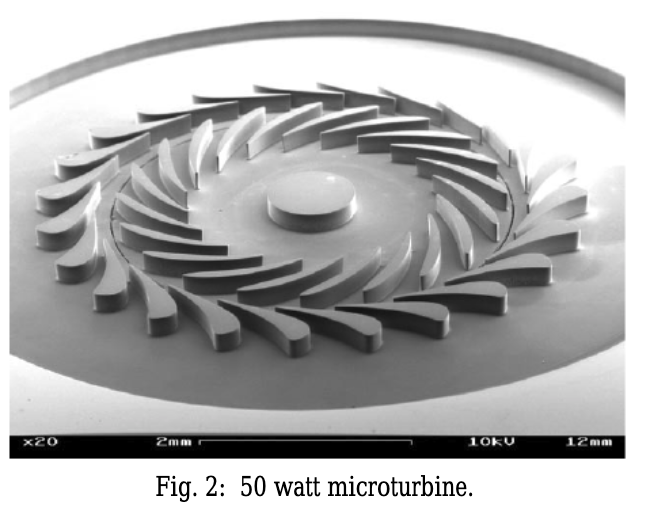
The turbine rotor of the MIT microengine, etched into silicon. It is four millimetres across, the blades stand 200 microns tall, and the running gap between rotor and baseplate is ten microns. Image: MIT.He chose small engines as his undergraduate research subject. One of the leading places working on them was MIT, so he went to look at it in his third-year summer, and back again in his fourth to meet the professor.
What made him certain was not the engine. It was a piece of art.
On a trip to the MIT Museum he came across Arthur Ganson's Machine with Oil, a kinetic sculpture whose entire function is to maintain itself. A mechanical arm reaches into a pan of oil, lifts it, and pours it back over its own workings. A machine that lubricates itself, and does nothing else. The artist's own label reads: If I was a machine, what would I love to do? Bathe myself in oil, of course.
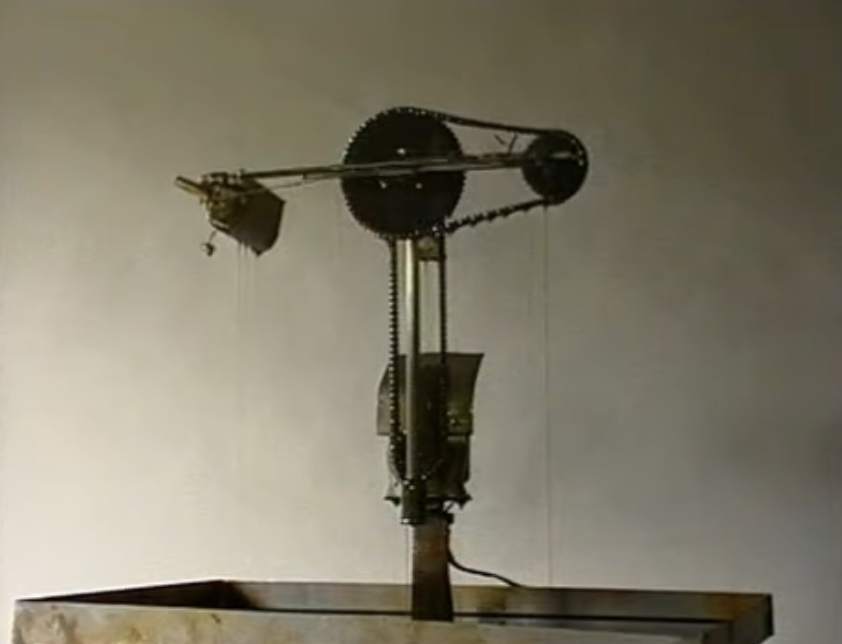
Arthur Ganson, Machine with Oil (1990), from the artist's long-running exhibition at the MIT Museum. Image courtesy of Arthur Ganson."If this is permitted here," he remembers thinking, "if this is a place where you can go all out on something like this. That would be interesting."
He took leave from the University of Tokyo and went.
What he found there was less about engines than about method.
The textbooks were the same ones. The examinations were not. In Japan, he said, competence was demonstrated by knowing: I know that result, I can solve that equation, someone published that in the eighties. At MIT the equation was assumed. Of course you can solve it. Credit came from something else. You had to be able to say what would happen, and why, when a condition changed.
He reached for an example from a jet engine, because that is where he reaches. Air accelerates through a nozzle and chokes at the throat. Now double the inlet temperature: what happens downstream?
"It should go as the square root," he said, "because of how the scaling works. So the answer is this."
He was not, he made clear, good at this initially. He struggled. Students from other countries told him they had never been examined this way either.
But the habit stuck, and it is the habit that matters: separate what is primary from what is secondary, and be able to say why. It is a disposition for finding the load-bearing variable in a system that appears complicated. Two decades later, it is what he sells.
The talk that took twelve years
The laboratory ran a seminar series with outside speakers. One of them was Nicholas Cumpsty, a visiting professor at MIT who had been professor of aerothermal technology at Cambridge's Whittle Laboratory and chief technologist at Rolls-Royce, and who is now emeritus at Imperial College London. He wrote the textbook a great many propulsion engineers learn the subject from.
Cumpsty came to talk about jet engines. What Tanaka remembers is not the engineering.
The inefficiency that remained was somewhere else. Not inside the engine, but in the requirements the engine is built to satisfy.
His example was the climb. The rate of climb an aircraft has to achieve is set by the operational requirement, and the engine must be sized to deliver it. Cumpsty's argument was that the requirement itself is pitched higher than anything actually demands. Relax it, and the efficiency of the whole system improves.
Tanaka was in his early twenties. He did nothing about it for twelve years.
"That story stayed in my head," he said. "When I was thinking about ideas, I remembered it."
When he did come back to it, he came back in character. He read Cumpsty's original paper. He put the claim to working pilots, to check whether the problem was real at all. Then he started writing to the authors of the other papers he had been reading, among them the NASA team behind TASAR, a project that put a traffic-aware advisory tool on the flight deck so that crews could ask for better routes and altitudes while airborne. He asked them what they made of it.
The method has not changed since; only the scale has. Not long after founding the company, he approached Eri Itoh, an aeronautics professor at the University of Tokyo and a senior from his own undergraduate department, with a version of the same question. He wanted to control the descent path and speed actively. Was that a real thing? She told him about fixed flight path angle descent, which holds the descent angle constant instead of stepping down under controller instruction.
Two years later, NABLA, the university laboratory and Peach Aviation had flown it on scheduled commercial services, the first such demonstration anywhere as far as the parties could establish, showing that the technique is compatible with air traffic control and manageable for the crew. In simulator testing, the saving came to roughly 190 pounds of fuel per flight, about one percent of what an A320neo burns on a typical Japanese route. Airlines chase savings like this through stacks of small measures, and a hundred pounds a flight is a serious result. Nearly twice that, from a single change to the descent, went down well with people in flight operations. In principle, it would work on every descent, on aircraft that are already flying.
It is the same move as the emails. Go to whoever knows, and ask.
Cumpsty's example was the climb. Itoh's answer was about the descent. The product the company went on to build works on the cruise. Between them they cover the whole flight, and none of them is about the engine.
Everything that can be done, has been done
He joined IHI and worked on gas turbines for three years, some of it in research and development, which is where the trouble started.
The efficiency curve for commercial aircraft, measured as fuel burned per passenger per kilometre, falls steeply from the beginning of the jet age and then flattens. The most recent meaningful step down came from materials. Composites made airframes lighter. That work was funded in the early 2000s and reached service more than a decade later.
This is the shape of the industry Tanaka describes. Thermal efficiency of 43 percent becomes 44 percent, and that is a real achievement, celebrated accordingly. Bigger fans are better, so fans have been enlarged until ground clearance stops them. Larger fans are heavier, so they are built from carbon. Hotter cores are more efficient, so the hot section is cooled until it cannot be cooled further, and then ceramic matrix composites are introduced so that it need not be.
"All of this is known," he said. "Everyone is doing it. Everything that can be done is being done."
By the time a technology is announced as new, he pointed out, it is ten or fifteen years old inside the industry. In the R&D division where he sat, he watched colleagues struggle with the recurring question of what came next, and arrive at no comfortable answer.
There is a figure he returns to. The part he worked on was the combustor, the hottest place in the engine, and its combustion efficiency, the share of fuel that burns rather than passing through unburnt, already sat at about 99 percent. That is not the engine's thermal efficiency, which is a different and much harder number. It is the burner's own job, and the burner had essentially finished doing it. The exhaust from a modern jet engine, he said, is cleaner than a petrol car's. And research proposals kept arriving with titles about making it cleaner still.
"I stopped being able to tell," he said, "whether continuing to chase that problem was contributing anything to solving society's problems."
His objection was not that the work was hard. It was that it was very nearly done.
He is not, however, writing engines off. Ask about the remaining ideas and he brightens. Take open rotor. It is a propeller, essentially, returning after the jet age, shelved in the 1980s because the noise was intolerable. People are working on it again, on the theory that the materials have caught up. Or heat recovery, standard on the ground for decades but too heavy to carry, until hydrogen made a heat exchanger necessary anyway and the idea came back.
The point is not that engines are finished. It is that the gains left in them are locked behind a development process built to prevent surprises.
His conclusion was not that engines had stopped mattering. It was narrower than that. The room that was left was somewhere else.
"Everything that can be done is being done."
Tanaka spent three years on gas turbines before concluding that the remaining headroom was somewhere else.
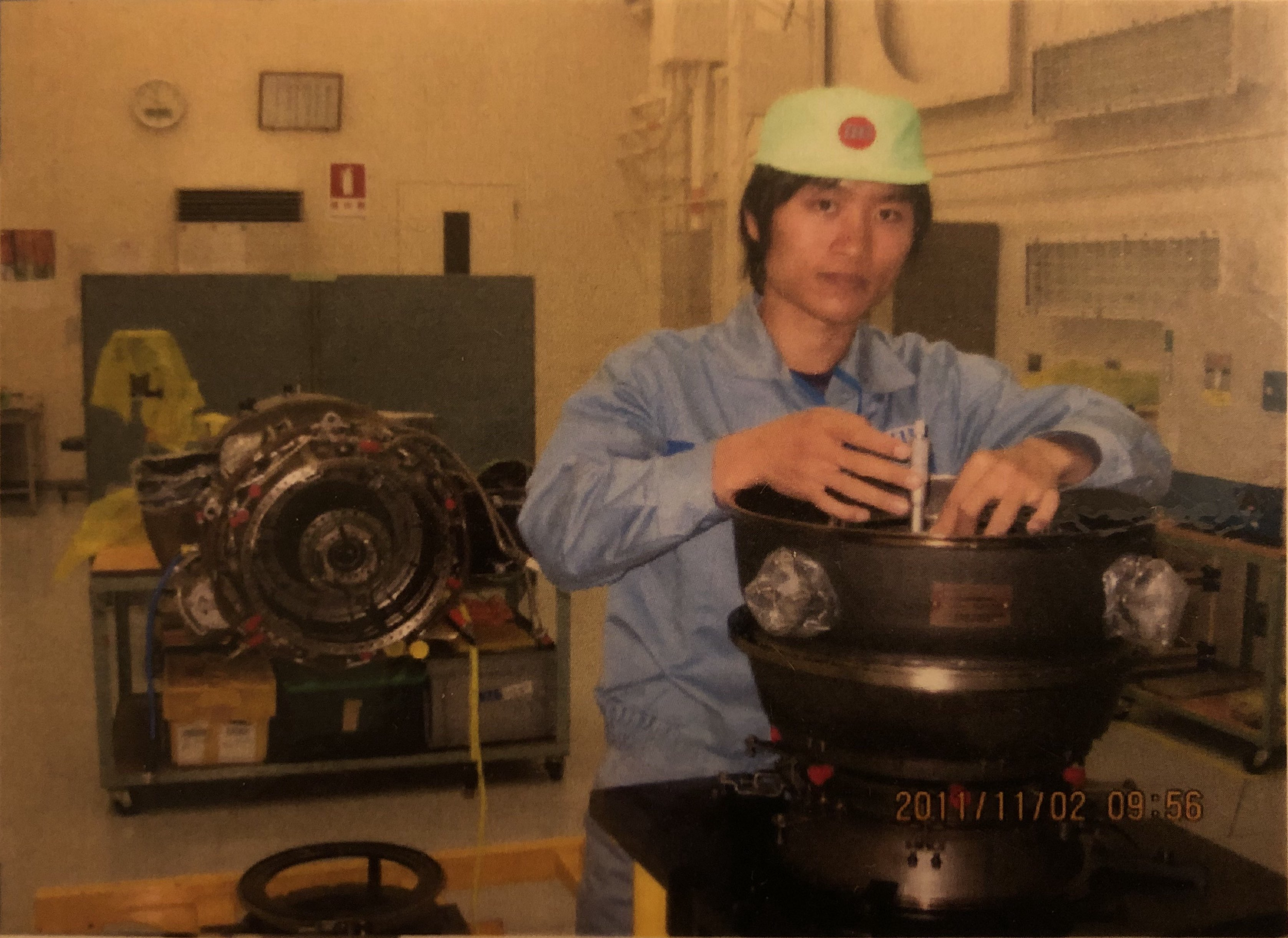
Tanaka at IHI in November 2011, during training for new engineers.The reversal
So consider the shape of this.
A young engineer, trained to believe that the honourable work is building the machine, sits in a seminar and hears a distinguished builder of machines point out that some of the inefficiency sits outside the machine altogether. He files it away. Then he goes and builds machines anyway, for three years, at the company whose commercial had sent him down this path in the first place. Then he leaves, deliberately, to learn how markets and organisations actually work, which he knew he could not do. He spends seven years at a strategy consultancy. When he finally sits down to ask what he actually cares about, the seminar comes back.
He did not change his mind about what is interesting. He applied the same test he applies to indigo, and the answer changed, because the objects had swapped places. Propulsion was nearly done, at least on fuel burn. The daily business of deciding how an aircraft should actually fly was not.
Cumpsty had been right all along. Until recently, there was no practical way to act on it. Then the tooling caught up. Satellite links became wide enough that a cockpit could be treated as a connected device rather than a place that receives short text messages, and machine learning became dependable enough to stake an operation on.
What is actually unfinished
Commercial aviation is not behind. It is a spectacularly reliable system with a safety record no other mode of transport approaches. The problem is that precision has been mistaken for completion.
Start with altitude. An airliner in cruise is not flying at a measured height above the ground. Above the transition altitude, every aircraft sets its altimeter to the standard pressure datum, 1013.2 hectopascals, and flies a surface of constant pressure, called a flight level. The number on the instrument is an inference from air pressure, assuming a standard atmosphere.
The atmosphere is not standard. Fly into a region of lower pressure at an unchanged indicated altitude and the aircraft is, in fact, lower. The FAA teaches this with a rhyme: going from a high to a low, look out below. The larger the pressure difference, the larger the gap. Real altitude is quietly gained or given away, while the instrument reads exactly the same number the whole way.
So aircraft do drift up and down over the course of a cruise. Climbing costs fuel. Some of that climbing is not buying anything.
The obvious response is to fly the altitude that is actually optimal. Nobody is allowed to. Above flight level 290 (FL290), reduced vertical separation minima stack traffic at 1,000-foot intervals, with direction of travel assigned to odd and even levels so that opposing aircraft cannot occupy the same one. Changing level requires clearance from air traffic control, which may or may not be available.
None of this is going to change, and it should not. Every aircraft flies the same pressure datum precisely so that separation works whatever the weather is doing. A system this large, and this dependent on never failing, does not get redesigned because someone has built a better optimiser.
There is no dial to turn. The aircraft can be at FL290, or FL310, or FL330. There is no FL295, and no FL303. The question is never how high to fly. It is which of the available levels to take. Tanaka's description of the situation is the cleanest I have heard:
"In a sense it's an integer problem. It's this one, or this one, or this one. It's only ever a choice among options."
The question is not how to escape the menu. The menu is load-bearing, and it is staying. The question is which item to take, several times per flight, given this particular airframe, this particular weather, and this particular day. That question is already being answered, continuously, by flight planning systems and by pilots. They answer it with tools that know less about all three than they could.
Closing that gap is a considerably smaller claim than fixing aviation. It is also the reason there is a company here at all.
Then there is turbulence, which is where the aircraft's own instruments run out. Onboard weather radar returns an echo from precipitation, from raindrops and hail and wet snow, and from nothing else. Clear-air turbulence carries no precipitation, and the radar does not see it.
Forecasting has not filled the gap. The standard operational indicator is wind shear. A sufficiently large velocity difference between layers implies elevated risk. It is genuinely useful. It is also one term.
Wind shear describes how fast the wind changes from one layer to the next. What actually throws an aircraft around is whether the air itself is churning, and those are not the same question.
"It's one of the factors, certainly," Tanaka said. "But what actually matters is how much non-steady effect there is to destabilise the flow."
What his company assembled instead is unglamorous: three-dimensional distortion in the flow field, the buoyancy contribution of water vapour, and terrain. Air displaced over a mountain ridge generates mountain waves, and those shake aircraft.
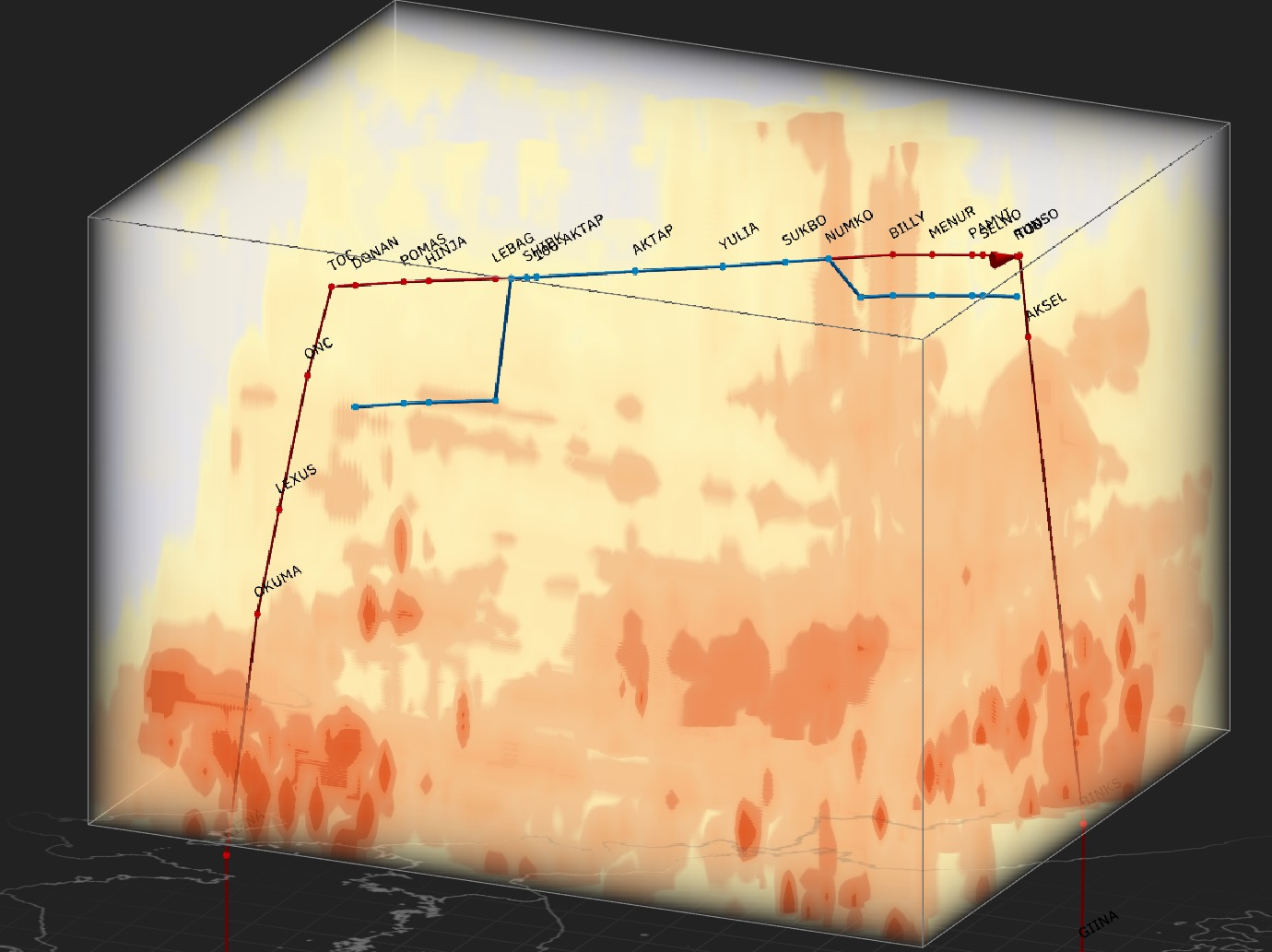
NABLA's turbulence forecast for the sky around a single flight, drawn as a block of air above the map. The darker the orange, the rougher the air is expected to be. The lines are the flight's original and recommended paths.Terrain data had not been in these models. The inputs were available. The research literature said it could be done.
"Hardly anyone had actually put it all into a model," he said. "In research, people said it was possible. But actually implementing it and deploying it globally, that didn’t exist when we started the company."
Then, more plainly: "Everyone kept saying turbulence was unpredictable. So we thought, well, let's try."
Building for the seam
What the software does, stripped to a sentence, is answer the same question over and over. Which level should this aircraft take next, given where it is, what the air ahead of it is doing, and what this particular airframe burns at each level available to it?
The turbulence and the fuel are not two products. Avoiding turbulence means choosing a different level. Choosing a level is also how you save fuel. The two questions share an answer space, and existing tools address them separately. Answering them together is the claim.
NABLA's products are also shaped by an unusually clear-eyed view of where an outsider is allowed to stand.
The company does not attempt to replace flight planning systems or reach into air traffic control. Its software arrives as an application on the electronic flight bag, the tablet already in the cockpit, and it advises. Recommendations are constrained to the discrete levels the aircraft is actually permitted to occupy.
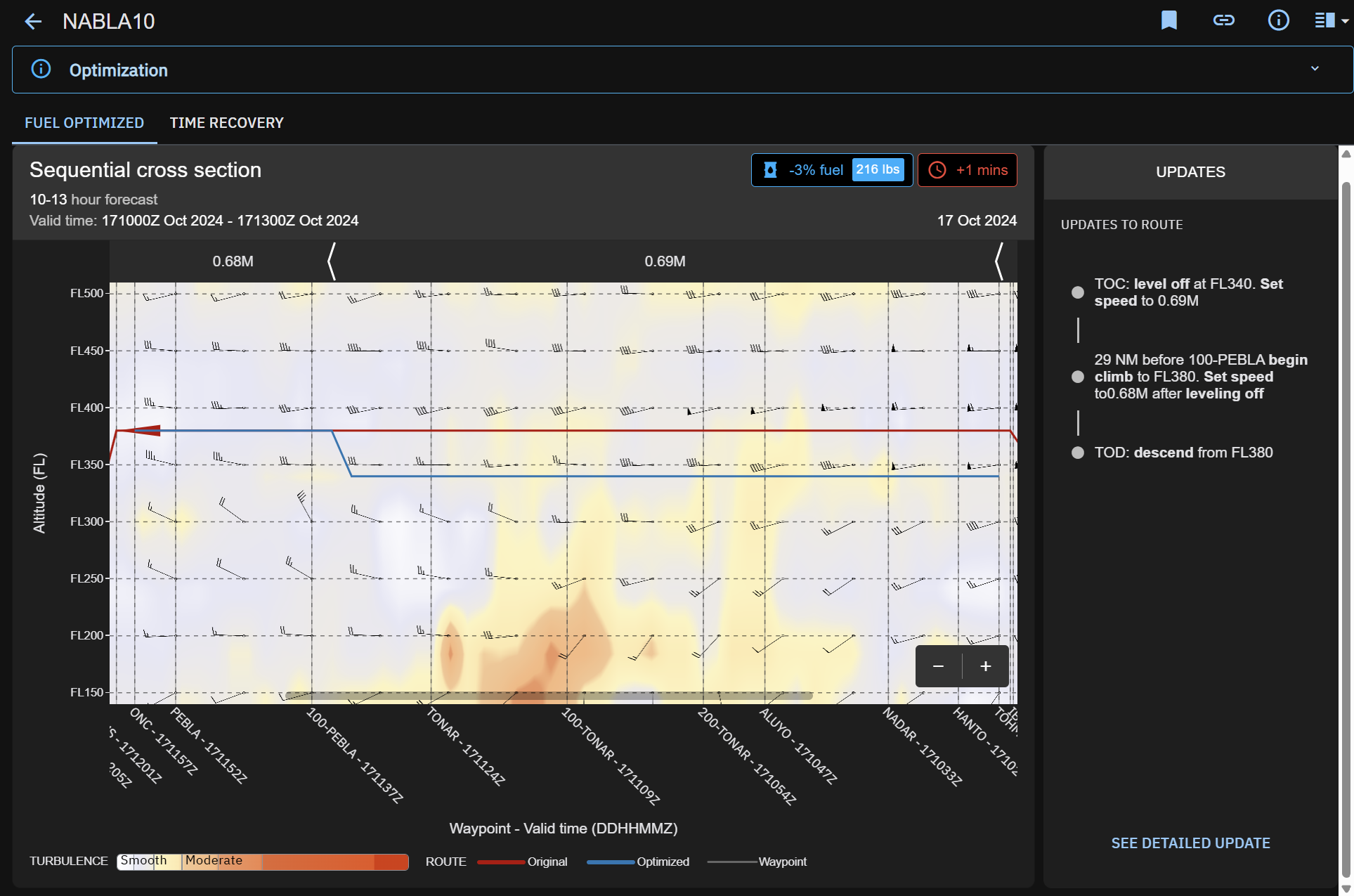
The same software, comparing two cruise profiles for one flight. The red line is the original plan, the blue line the recommendation, and the shading is forecast turbulence. Here, flying lower for most of the cruise was estimated to save about 3 percent of the fuel, at the cost of one minute.Underneath is machine learning trained not on aircraft types but on individual airframes, by tail number, against recorded flight data. The turbulence models are trained against records of encounters that actually happened, drawn from pilot reports and recorded aircraft measurements.
The company reports recall rates for turbulence prediction several times better than conventional methods, and, on the flights where its recommendations are actually taken, a saving of a few percent on the fuel burned in the cruise.
Tanaka is notably careful about what those figures mean, in a way that vendors usually are not.
There are two ways to score a prediction, and they pull against each other. Recall asks: of the turbulence that actually happened, how much did the model warn about? Precision asks: of the warnings the model issued, how many were real?
Suppose a model simply declares turbulence everywhere, all the time. Every bump that happens was predicted, so recall is perfect. But almost every prediction it made was wrong, so precision collapses. Tighten the model until it warns only when it is certain and the two numbers swap places.
"What we publish is recall," he said. "If you become the boy who cried wolf, that number gets very good. Say there's turbulence everywhere and you'll always be right."
They track precision internally alongside it. They publish recall because two numbers confuse people, and because, as he put it, almost nobody outside the field reads statistical accuracy correctly.
It is an odd thing for a founder to volunteer. It is also the most persuasive thing he said all afternoon.
And it is worth putting that fuel number next to the ones from earlier in this story.
A generation of engine development moves thermal efficiency by roughly a percentage point. It takes ten or fifteen years to reach service, and then decades more to reach the whole fleet, because airliners stay in service for twenty-five or thirty years. The composite structures that produced the last real step down in fuel burn were funded in the early 2000s and are still working their way through the world's aircraft.
A few percent of cruise fuel, delivered as software, arrives on the aircraft that are flying this month. There is no fleet to replace.
That is the argument, and it is not a modest one. If the figure holds up across other airlines and other route structures, which is precisely what has not yet been established and what Tanaka is careful not to overstate, then the largest near-term reduction available to commercial aviation, and to its emissions, is not in the machine at all. It is in how the machine is flown.
Which is what a visiting professor told a graduate student, in a seminar room, twenty years ago.
There is a naming convention in the product line that is hard to miss once noticed. The company is named for the nabla operator, ∇, which bundles the partial derivatives of a function across all of its variables. Optimisation is the business of using those derivatives to find an extremum, which, as Tanaka points out, is a reasonable description of what the company does. Its products are named for what they do to complexity: untangle it, then weave it back.
Which is, more or less, indigo dyeing.
Where he is starting from
Ask Tanaka whether this is a Japanese company and the first answer is immediate. Aircraft cross borders; the industry is one industry; the business was global from the start.
The second answer is more complicated.
Japan has wanted to be serious about aerospace for a long time. It appears in national strategy documents. Universities are funded for it. And yet, Tanaka noted, if you ask whether the world regards Japan as an innovative force in this sector, the honest answer is no.
He offered an illustration, with the caveat that I could use my judgement about printing it.
Japanese manufacturers describe themselves as engine makers, and in an important sense they are. They build components that almost no one else can build. But none of them leads an engine programme.
"Japan doesn't have an engine OEM for commercial aircraft," Tanaka said.
The formal term for the relationship is risk-sharing partner. He was blunt about how it feels from inside: the prime contractor's design arrives, gets fully reviewed, gets sent back when it falls short. You must keep bringing new technology or you stop being included. And the primary keeps the parts that are difficult and profitable, and passes down the parts that are technically low-risk.
When the 787 entered service, he pointed out, the campaign that ran in Japan was Made with Japan. The photograph showed one man in a suit and a Boeing hard hat, standing among his Japanese partners. No such advertisement ran in the United States.
The same pattern holds in software, more completely. The reservation systems behind Japan's largest carriers run on a Spanish platform. Operations software vendors cluster in Europe and North America, around Airbus and around a business spun out of Lufthansa's IT division. In Europe, people move between airlines and vendors routinely; in Japan, careers stay inside the airline.
Tanaka is careful not to make this a grievance. Being a good supplier is a legitimate business, he said, and without it Japan would have less employment and a smaller economy.
But:
"Everyone keeps saying we have the technology. But nobody has gone out and led anything."
And then, quietly: "I'd like to be the one that changes that."
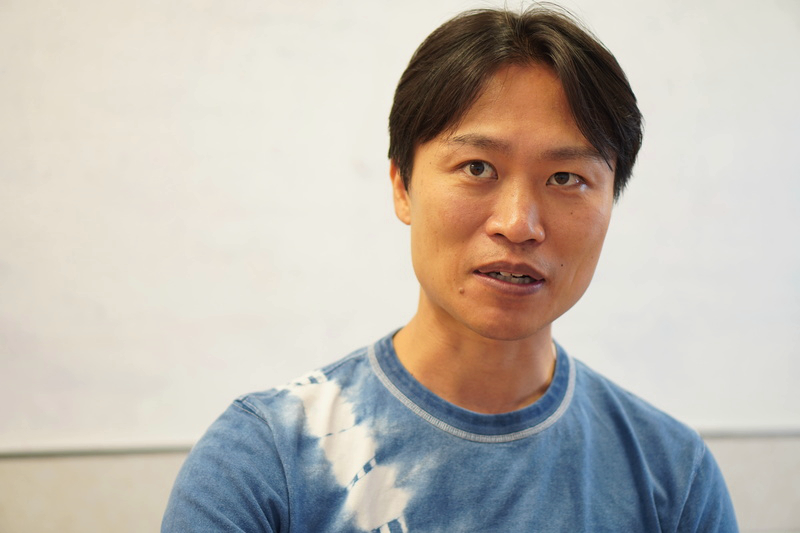
He mentions, without elaborating, that he tried to do something about it while he was at IHI, and that he was too green, and that it came to nothing.
Some of the people who backed the company early put it more strongly than he does. One of them told him that this industry had been taken from Japan, that the country built formidable aircraft once and has been dominated by the West ever since. Tanaka was struck enough by the phrasing to have started using it himself.
He is unreserved about the people doing the dominating. "They're impressive," he said. "Genuinely impressive. They make the rules and they build the systems, and the rules are ones they can win under. They make the rules, and they make the things."
He is more confident about what Japan can actually offer, and it is not computing power. "That's all bought in," he said. "We don't have some uniquely fast chip." What he wants is attentiveness. Interfaces built by imagining what the person on the other side actually needs, rather than implementing the specification literally. He hired a product designer as his second external employee, far earlier than a company at that stage normally would, because he had decided that design mattered, in operations software as much as anywhere, and that it was the thing to invest in first.
And he reports that airline customers frequently frame Japan as an advantage in a different way: this is congested, fussy, difficult airspace, and if it works here it will travel.
He has some evidence for the fussiness. Japan's airways are described by a dense lattice of waypoints, and aircraft are, in principle, meant to stay on those lines. Add what comes with it, the terrain, the noise rules, the military airspace, the concentration of domestic and international traffic into a small area around Tokyo, and the result is an operating environment with very little slack in it.
"Japan is known for being fine-grained," he said. "People say: Japan is hard work. They ask for such detailed things."
It is not the only such place. London, the Benelux and western Germany, the airspace around Paris, southern California: all of them run dense, constrained, awkward operations of their own. Which is rather the point. Something built to cope with one of them is built for a category, not for a country.
None of which makes this a Japanese company in the sense that matters commercially, and Tanaka is explicit that it never was. Aircraft cross borders. The industry is one industry. The business was built for a global market from the first day, and the two airlines now running trials outside Japan were always the point rather than a later ambition.
The structural story is why he finds the work worth doing. It is not the market he is selling into.
The part that cannot be solved with mathematics
Near the end, I asked about the gap between being right and being used. The recommendation is sound; the aircraft flies the old profile anyway. Is that regulation, or operations, or something in people's heads?
"The mindset component is very large," he said.
He was careful about it, and generous, in a way that suggested he has thought about it more than he has been asked to.
For decades, the people in these roles have absorbed information that exists only at the sharp end, made a judgement, and taken responsibility for delivering passengers safely. That is the job, and they have done it well. Now something arrives with more computing power and a different answer.
"Being told, here, do it this way. Of course that's unwelcome. There's an existing method. It doesn't match my instinct. I can't see why the number is what it is. Toward people who have held all the authority until now, that reaction is completely reasonable."
And then the structural problem underneath it, which he identified with unusual precision.
"In this industry everyone is acutely aware that you can't run the counterfactual," he said. "You can't fly the same flight twice by two different methods. There are too many conditions, and the conditions are different every time."
Which means the number is always arguable.
"So people say about that five percent: that's a number you made up, isn't it. That's a simulation. What were the weather conditions that day? Anyone who dislikes the change can find a reason, endlessly. Compared to what? A delta means you compared it to something. And then it becomes a question about that something, and it goes on forever."
Evidence from another airline does not settle it either. Show a carrier what the software achieved elsewhere and the response is: well, that was them.
The ones who are open to it accept the argument and look for a chance to try. The ones who aren't dig in.
And then the sentence I keep returning to.
"The fact that the other side are professionals too is what makes the problem hard."
There is no version of this that is solved by a better model. It is solved, if at all, by time, by familiarity, by generational turnover in the operations room, and by finding ways to show the reasoning rather than the conclusion. His designer is working on that now, and Tanaka is explicit that it will not be fixed with better data visualisation alone.
Then he said the thing that made the afternoon cohere.
"The fact that it's difficult, that people are involved, that part of it is a human problem and not only a technical one. That's what makes it interesting. It's an interesting world."
Every airline has a different culture, he went on, and asks for slightly different things, and something new arrives each time, and he enjoys that.
"I'm enjoying the challenge."
In a seminar room at MIT, Tanaka was told that some of the inefficiency in aviation sits outside the machine. He went and built machines anyway.
He is now describing the least tractable, least mathematical, most stubbornly human corner of the problem he was pointed at, persuading experienced professionals to trust a number they cannot check, and calling it the interesting part.
He is also collecting the ash from his barbecues, because he would rather make the alkali himself.
"The fact that it's difficult, that people are involved. That's what makes it interesting."
SHINJI TANAKA
Founder & CEO
Shinji Tanaka founded NABLA Mobility in 2021. Before founding NABLA Mobility, Shinji worked as a project manager in BCG (Tokyo & Atlanta) for 7 years, supporting corporate strategy development, M&A, and operational transformation of various global companies. He also worked as an aircraft engine engineer at IHI for 3 years. Shinji had finished his internship at Max-Planck Institute in Germany.
Shinji holds a Master's degree in Aeronautics and Astronautics from both MIT and the University of Tokyo respectively.
Ken Nishimura is a writer in Tokyo. He was previously editor-in-chief of TechCrunch Japan and a partner at Coral Capital, a Tokyo-based early-stage venture capital firm.
Our vision
We aim to unlock a new era of flight and achieve comprehensive efficiency by applying new ML/AI techniques, and building deeply coordinated solutions that will drive operational efficiency and decarbonization.